
If you’re into hidden histories of socialism, feminism, and forgotten women who helped shape modern political thought, this article is for you. Written by Sam Dobbie, this piece explores the remarkable life and ideas of Flora Tristan, a nineteenth-century French-Peruvian writer and activist who called for workers to unite before Marx and Engels made the phrase famous. From her troubled personal life and travels through Peru and London to her groundbreaking work on class, gender, and workers’ rights, the article reveals why Tristan deserves to be remembered as one of the most important — yet overlooked — voices in the history of socialism and feminism.
‘Peregrinations of a Pariah’: The Socialism of Flora Tristan (1803-1844)
In 1864, the first International Workingmen’s Association was founded. The aim of the First International was to unite political groups and trade unions across Europe to increase the prospects of the working-class. Karl Marx, the co-author of the Communist Manifesto, played a leading role in the First International. Given the nature of the Communist Manifesto, this comes as no surprise. Marx was, after all, one of the founding fathers of socialism. Since 1848, Marx had been at the forefront of outlining the goals and principles of the working class, or what he termed ‘the proletariat’, in overthrowing capitalist systems. Marx recognised the class struggles that existed within society, which were heightened by the conflict between the oppressors and the oppressed. Ultimately, he called for workers to unite. In fact, the slogan ‘Workers of the world, unite!’, came to define the Communist Manifesto and the subsequent movement inspired by socialists such as Marx and Engels. For this reason, Marx is rightly remembered for his significant contributions to socialist theory.
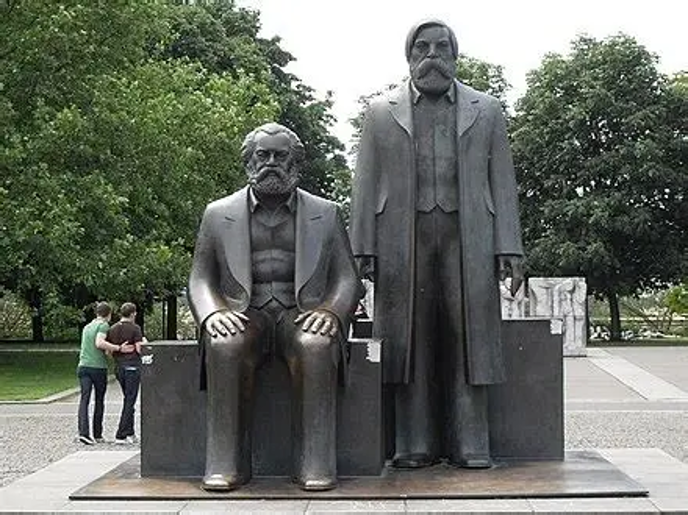
The Bronze Statue of Karl Marx and Friedrich Engels in Berlin, Germany.
However, were Marx’s arguments truly that novel? The answer is no. In 1843, five years prior to the Communist Manifesto, someone in France was already discussing the struggles facing workers and the need for workers to unite. What’s more, that someone was a woman.
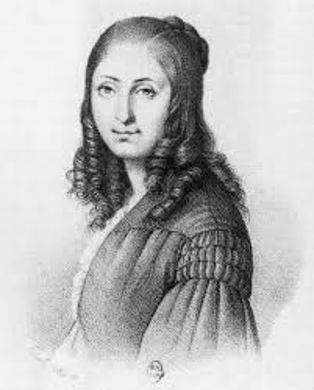
Flora Tristan by Jules Laure (1806-1861)
Born on 7 April 1803, Flore Célèstine Thérèse Henriette Tristan y Moscoso was born in Paris. The daughter of Anne-Pierre Laisnay, a French émigré who fled to Bilbao during the French Revolution, and Don Mariano Tristan-Moscoso, born in Peru and a colonel of the Dragoons in the Spanish army, Flora was born into a comfortable existence. This comfort was not to last as, in 1807, Don Mariano died prematurely and left his wife and young children in financial difficulties. This is because the marriage of Don Mariano and Anne-Pierre was never legalised. Their marriage had consisted of a religious ceremony, but they never had a civil service which, under revolutionary laws, was required to legitimise marriages. Consequently, Anne-Pierre was a defacto wife and Flora and her brother were illegitimate.
From this point, Tristan’s status rapidly declined and her experiences helped shape her later works and mission to help those living on the margins of society. Unable to legitimately claim the estate at Vaugirard and deprived of financial support from Don Mariano’s family in Peru, Anne-Pierre and her children moved to the countryside. During their time in the countryside, Flora’s younger brother died aged ten. In 1818, Anne-Pierre and Flora returned to Paris. They lived in the Latin Quarter on the rue du Fouarre, which intersected with the rue Dante, the rue Galande, and the Place Maubert. This was an undesirable area of the city to live, riddled with thieves, hawkers, beggars, and prostitutes.
At the age of seventeen, whilst working as an apprentice lithographer, Flora married André Chazal, an engraver who was also her boss. Chazal proved to be a poor choice of husband – he was a gambler, an alcoholic, and a violent individual – and by the time Flora was twenty-one, she had left him. Finding work as a separated wife proved to be a challenge, and she took the position as a ladies’ maid for two wealthy English women. To secure this position, Flora fashioned herself as a young widow in desperate need of employment to support her young family. This narrative leant her the respectability she would not have had had she admitted to living apart from her husband. This is because according to articles 213, 214, and 1124 of the Napoleonic Code, wives owed their husbands obedience, had to live with their husbands and follow them wherever they chose to reside, and women, alongside minors and the mentally incapacitated, were considered legally incompetent to sign contracts without patriarchal authorisation. The position as ladies’ maid offered Flora considerable independence and, alongside these women, she visited England, Italy, and Switzerland before returning to Paris in 1828. Upon returning, Chazal began a harassment campaign against her, so she had to continuously move around.
Between 1833 and 1834, Flora travelled to Peru to seek an inheritance from her father’s estate. This was at a time when women typically did not travel alone. She gained many valuable experiences in Peru, witnessing the likes of revolution, social inequalities, and the backwardness of Peruvian society in contrast to Europe. She also secured a small pension from her uncle, Don Pio. In 1837, Flora published Pérégrinations d’une Paria, travel diaries from her time in Peru, in which she also disclosed some of the miseries she had faced in her domestic life with Chazal. Furious with this work, which he ordered to be burned in the streets of Lima, Don Pio stopped Tristan’s inheritance, but by this time she had saved enough to survive alone, enjoying a modest lifestyle. This was just as well given that, in 1838, Chazal, shot Flora in broad daylight near her Parisian apartment. He was sentenced to twenty years hard labour, and Flora gained full custody of Aline and Ernest.
In the aftermath of her near-death experience, Tristan decided to take up the issue of improving the lives of women and workers. In 1840, she published Promenades dans Londres, which contained observations of her visits to London in 1826, 1831, 1835, and 1839. This work contained class and gender analysis of various spaces, buildings, and people. Flora visited prisons, brothels, factories, the Jewish Quarter, the Irish Quarter and the Houses of Parliament (disguised as a man!), and she witnessed poverty, physical and mental illness, and the abject misery of the workers. Promenades dans Londres, in many ways, served as a forerunner to Engels’ The Condition of the Working Class in England (1845). Where Engels based his work on extensive academic research, Flora drew on her own observations, lending her work a more human touch. Her experiences in London prompted her to take up the case of workers across France and inspired L’Union Ouvrière, arguably Flora’s most recognised work.
First published in 1843, L’Union Ouvrière underwent three editions during Flora’s short lifetime. Getting it published, however, was no easy task. This work encouraged workers to unite and emancipate itself. Writing at a time when an organised male workers movement existed as an independent force in France, and when workers had their own newspapers such as the Atelier, the Artisan, and the Union, Flora knew that she was operating in a masculine arena. Nevertheless, she openly criticised the leaders of the workers of having a narrow focus and proposed a program that would tackle the miseries workers faced by offering them access to work, an education, and political representation. Due to the radical nature of this work, no one wanted to publish it, so Flora set about collecting the necessary funds to have it published. She visited more than 200 people, secured 123 subscribers, and successfully published 4000 copies in May 1843. By January 1844, she secured a further 102 subscribers and published a second edition consisting of 10,000 copies. A final edition of 10,000 copies was published in June 1844. Flora travelled across France promoting her ideas. It was during this tour that she died from typhus in Bordeaux at the age of 41.
Interestingly, despite being aware of the male audience this text would likely attract, Flora included a chapter on women and the role they could play in her plan for the workers. This was a bold move given that the woman question remained of secondary importance and was not really a serious question until 1848. Her work went further than that of Marx and Engels because it made a direct link between the oppression of workers and women. Furthermore, she created a nine-step plan of action which included appointing a defender to represent the political needs of workers, recognising the right to work for men and women, educating the children of workers, and recognising equality between the sexes. In many senses, Flora, in advance of Marx, created a first workers’ international. Flora is difficult to define because she was from a working background but believed that she belonged to at least the bourgeoisie; she was French with Peruvian roots, so had a certain exoticism to her; and she was physically and emotionally separated from her husband but remained legally connected to him because divorce was not possible. This has made her somewhat of an enigma to scholars.
Despite Flora being described as the most celebrated French feminists of the nineteenth century, she has been largely neglected. Her contemporaries certainly acknowledged the significance of her work. Some, such as Victor Considerant, praised her for the fervent enthusiasm she displayed when campaigning on behalf of workers. Others derided her, calling her ‘the O’Connell of France in skirts’. For many of the workers, Tristan was ‘the mother of the workers’, and following her death they erected a monument in her memory in the cimitière de la Chartreuse in Bordeaux. This monument bears the inscription, ‘In memory of Madame Flora Tristan, author of the Workers’ Union with the workers’ gratitude. Liberty-Equality-Fraternity-Solidarity.’ Her work may not have been referenced by either Marx or Engels, but it certainly inspired them. Since 1925, with Jules Puech’s ground-breaking study of Flora Tristan, there has been increasing interest in her, especially in France and the United States. Whilst there remains considerable work to be done on uncovering the true extent of Flora’s significance to the development of socialist and feminist theories, things do appear to be moving in a positive direction.
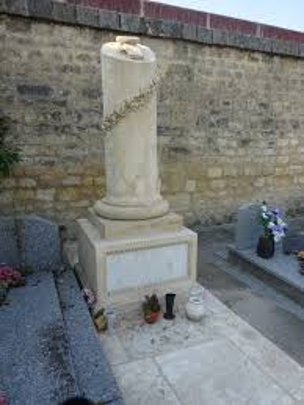
Tombe Flora Tristan, Cimitière de la Chartreuse
Author:

 English