
Louis MacNeice didn’t see history as a dusty textbook, but as a ‘palimpsest’—a document that is constantly written over, erased, and rediscovered. In this article, Andie Kristina explores a poet who refused to write ‘dishonest’ propaganda, even as Europe drifted toward catastrophe. From his early mythic poems to the haunting ‘dull refrain’ of war in Autumn Journal, MacNeice captured the feeling of living through the 20th century’s darkest hours. Kristina shows how MacNeice’s work acts as a ‘museum’ of the human experience, recording everything from the ‘fluttered world’ listening to Hitler’s broadcasts to the personal toll of the Spanish Civil War. By focusing on the ‘raw data’ of life—like a platform ticket or a radio buzzing with news of ‘War’—MacNeice created a living record of a society in transition. This article reveals why MacNeice’s distrust of simple answers and his focus on the ‘flux of existence’ make him a vital voice for our own unsettled times.
The Mind’s Museum: Navigating MacNeice’s Living History
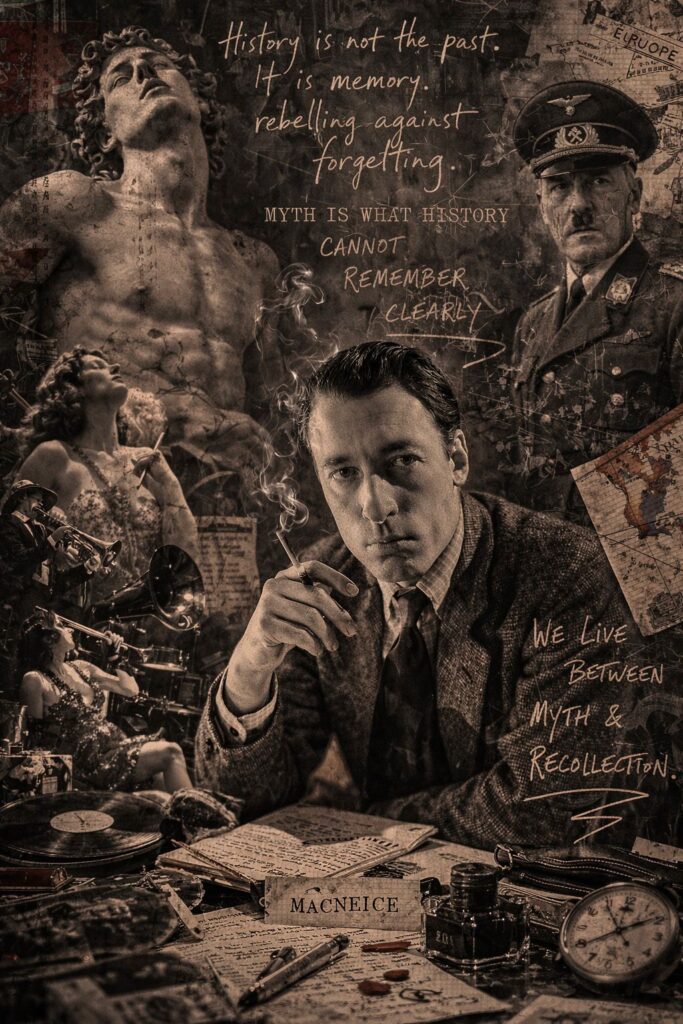
In a poignant declaration towards the close of one of his earliest poems, ‘Bound in Stupidity and Unbound’ (1927), from his inaugural collection, Blind Fireworks (1929), Louis MacNeice articulated a nascent philosophy that would subtly underpin his entire literary career:
My history is become a palimpsest,
H.M.S. Life is reported lost at sea.
That, my dear children, was the end of me.[1]
Together with the sensation of personal loss and ensuing dormancy, this powerful image of the poet’s history as layered, overwritten, and erased represents the fluctuations in both his literary corpus and posthumous reception. From his lifetime through several post-mortem decades, scholarship on his oeuvre saw alternating phases of sustained attention and relative scholarly quiet, a pattern distinct from the intensive re-evaluation it now commands. The above poem embodies this, capturing the vulnerability of MacNeice’s legacy to the tides of critical opinion and historical circumstance.
His commentators, such as Peter McDonald, have attempted to illuminate such issues: ‘critics who have invested heavily in such canonical schemes have always attempted to put the poet into an evaluative contest’.[2] Edna Longley, another of MacNeice’s advocates, argued that his cultural influence has been underwritten, although his work is able to speak across a range of settings: ‘On the one hand, his poetry has absorbed the communal experiences of four decades; on the other, it fully enters our perennial life of the senses and the psyche’.[3] Through MacNeice’s vivid, phenomenological register and historical-civic centrality, his poetic imagination internalises and re-articulates the outer world of shared history alongside the raw data of human experience, which are equally integral to his artistic language.
Nevertheless, this critical impulse—to locate, define, and rank—has frequently obscured rather than illuminated MacNeice’s significance, favouring coherence over the multiplicities that define his art. His name now conjures only a handful of images: a Thirties poet, the shadow of W. H. Auden, an Anglo-Irish man labelled a dubious sceptic, and (if anyone cares to look deeper) a writer obsessed with the slippery nature of time and identity.
While the 1930s are commonly dubbed a ‘low dishonest decade’,[4] he stayed clear of partisan politics, aware that the period endangered both individuality and the right to think independently: ‘in the Spanish Civil War some English poets were torn between writing good propaganda (dishonest poetry) and honest poetry (poor propaganda)’.[5] He so defies any conclusion precisely because he insists on remaining ethically, aesthetically, and historically attentive to the flux of existence.
D. B. Moore rightly observed that MacNeice ‘looked all his life for a unifying vision, but was too honest to persuade himself that he had ever quite found one’.[6] See, for example, the preface of Autumn Journal (1939): ‘In a journal or a personal letter a man writes what he feels at the moment; to attempt scientific truthfulness would be – paradoxically – dishonest’.[7] Moore highlights MacNeice’s refusal to fabricate the truth, while propaganda claimed to possess it. This tension makes clear why his poetry diverges from the false, ideologically-driven verse of the 1930s. As a result, critics have misread his work, leaving it without a proper home in the decade that produced his greatest output and consigning him to the backbench.
Given that ‘all genuine poetry feeds on historical fact’,[8] it is imperative to consider the temporal, social, and existential circumstances in which the poet’s work emerges. Blind Fireworks is no exception, exemplifying the ‘historical fact’ of post-war upheaval and the pervasive alienation that marked the 1920s; to analyse this collection is to enter the museum whereby MacNeice’s youthful musings are the foundational exhibit.
Written at the beginning of his career, the work bears the imprint of a self-conscious artist: displaying powerful, nostalgic imagery that is equally marred by stylistic overreach. MacNeice himself confesses as much: ‘Blind Fireworks is full of images such as I have described from my childhood but it is also full of mythological tags, half-digested new ideas and conceits put in for the hell of it’.[9] There is however a self-awareness that discloses the work’s intentional fragmentation. Let us consider, for example, ‘Adonis’ (1928):
In the wood Adonis walks and talks and wanders
Like crocuses that come from the womb, the tomb of silence,
Breaking winter bondage, spring fronds calling.
The old moon on tiptoe, with her blind face toward us,
Creeps round the cemetery to filch the flowers of memory
Offered by chapped fingers to bones below marble.
The moon has taken the flowers and left the bones forsaken,
So when he passes the gate of that granite and marble garden,
Glimpsing the moon’s theft through a chequer of cast-iron,
Adonis thinks of the hour when he too shall be flowerless.[10]
The classical figure Adonis, a once-mighty figure of vitality, contemplates his death inside a contemporary ‘wood’. Traversing through the cemetery, the reader becomes immersed into a threshold between life and death, where natural rebirth contrasts with human decay. It is reaffirmed by the fresh, tender infiltration of spring (‘Breaking winter bondage’) that contrasts the memorial-like post-war landscape (‘tomb of silence’). Furthermore, the moon is not an all-seeing cosmic figure, but an impersonal, abstract dread with a ‘blind face’. This blindness is not literal but symbolic of the Modernist condition: a worldview where perception is fractured, memory is elusive, and the search for meaning is futile.
The moon does not just steal flowers but the physical offerings left by the ‘chapped fingers’ of mourners, therefore seizing memories. With theft leading to abandonment, it symbolises the gradual and uncaring passage of time that obliterates both memory and tribute (‘Left the bones forsaken’). Time and death erase the emotional ‘flowers’ of memory, leaving only the cold and permanent ‘bones’ of history. By reducing an individual’s memories to a tombstone inscription, the cemetery becomes a catalyst for Adonis’s profound human epiphany: he ‘thinks of the hour when he too shall be flowerless’. He becomes increasingly conscious of his own mortality—a notion that mirrors MacNeice’s initial depiction of poetry as a historical place of negligence and recollection. The poem therefore does two things: it frames the mythic and seasonal rhythms of human finitude as a cycle of decay and renewal, and it returns to the first palimpsest metaphor that MacNeice uses to portray identity as a document continually overwritten and never wholly resolved.
‘Adonis’ is essentially an artistic representation of how history unfolds: a continual process of discovering, analysing, and ultimately lamenting what cannot be entirely recovered. It also serves as a mythic mirror to MacNeice’s legacy. Consider, for example, the seasonal emergence, his awareness of inevitable decline, and the moon’s theft of flowers. It emphasises that each successive layer of writing conceals but never quite obliterates the original vibrancy, akin to MacNeice’s confinement to the largely acknowledged decade of the 1930s. If we simultaneously look at MacNeice’s posthumous reception and ‘Adonis’, it becomes clear that one’s legacy is tethered to a timely bloom, whose later ‘bones’ remain only for those willing to scrape the marble and read the faint, still-visible script beneath.
‘Adam’s Legacy’ (1927), also part of the collection, turns away from primordial youth and beauty, instead examining the progenitor of humanity—launching a familiar cycle of decay and renewal. It opens with another mythic figure whose personal fate is used as a stand-in for the human relationship to the past:
Old Adam, having threaded his cocoon
Amid the oblivion of velvet leaves,
Rips a wheel from his mind’s torn chariot
And scuds it down the rainbow – rolling on
While Adam sleeps in history’s farthest groves
Encircled by the mouthing ocean’s moat.[11]
The shifting narrative of ‘Adonis’ and the fragmented syntax of ‘Adam’s Legacy’ produce a looping pattern that reflects how we retrieve memory and history: in disjoined, momentary pieces, not a smooth, nor entirely coherent narrative. By virtue of its longer length, sensory images become easily layered (moat, wind, gulls, pendulum, moonlight) into a historical palimpsest that must be unravelled, insisting that history be felt as well as studied.
Through a modern, myth-laden fashion, MacNeice demonstrates how the present is haunted by the past. For instance, both Adonis and Adam stand at a threshold (the cemetery gate, the wheel’s axle), and bear the weight of what preceded them, letting that awareness shape every action (‘Adonis thinks of the hour when he too shall be flowerless’, ‘He drowses, but his pain-spoked legacy / Pierces our marrow’). Rather than providing a linear autobiography, or being a solely egocentric project, Blind Fireworks emerges as a layered examination of history, memory and identity development that analyses many other figures from Narcissus, to Ganymede, and Pythagoras.[12]
MacNeice’s 1930s poetry ‘moves away from an interrogation of the self and towards an account of the subject within history’.[13] His earlier allusions foresee his later work, folding personal memory, contemporary politics and historical consciousness into one spiralling narrative. As we may anticipate from the title of Autumn Journal, it is a work of unmediated reportage that declines to expunge beliefs from context nor present a simplistic or dogmatic message: ‘But poetry in my opinion must be honest before anything else and I refuse to be ‘objective’ or clear-cut at the cost of honesty’.[14] The ethical importance of preserving intent lies in its ability to articulate truths exactly as they are recorded. It is a piece which masterfully embodies MacNeice’s more mature work: a combined poetic reflexivity, political critique, and diary-like immediacy, all without reaching any form of conclusion.
His resistance to advance a fixed doctrine, that is ‘neither final nor balanced’,[15] originates within the poem’s rejection of history as a neat, orderly account, emphasising instead its fundamental instability. MacNeice’s consciousness is intertwined with public perception, elucidating how global crises radically alter the texture of ordinary existence. History is a lived experience that is stripped of its heroic gloss:
Close and slow, summer is ending in Hampshire,
Ebbing away down ramps of shaven lawn where close-clipped yew
Insulates the lives of retired generals and admirals
And the spyglasses hung in the hall and the prayer-books ready in the pew.[16]
Note the visual motif of ‘insulation’ which evokes the suffocating cyclicality of historical conflicts—from the First World War and the Spanish Civil War to World War II—that undermine such hard-won leisure. This very leisure is disrupted as the imagery reflects Britain’s complex role as both a colonial power (‘spyglasses hung’) and a nation grappling with its moral and strategic position in a destabilising world (‘prayer-books’). The manicured and regimented exterior gives an unmistakable public image of order and control, but the ‘slow’ decaying image of summer mirrors how historical epochs fade. MacNeice presents history as a personal, material inheritance rather than an abstract chronology; it is a tangible, insulated layer that still governs the lives of its characters.
In Canto V we see a pattern of brief respite, followed by propaganda, and the eventual eruption of conflict. It begins with the weariness of war after a peace treaty, the ‘beautiful’ days before a totalitarian takeover and the sense of déjà-vu that societies feel when they recognise that past crises are repeating:
To-day was a beautiful day, the sky was a brilliant
Blue for the first time for weeks and weeks
But posters flapping on the railings tell the fluttered
World that Hitler speaks, that Hitler speaks
And we cannot take it in and we go to our daily
Jobs to the dull refrain of the caption ‘War’
Buzzing around us as from hidden insects
And we think ‘This must be wrong, it has happened before,
Just like this before, we must be dreaming;[17]
In 1938, the public sphere was saturated with Nazi propaganda; dissent had to remain private—often in the form of whispered conversations, secret diaries, or mental resistance. MacNeice, as the internal, unspoken counter-narrative, captures that very essence: ‘Hitler speaks’ as the enforced and broadcasted voice of the state, which leads MacNeice to think ‘This must be wrong […] we must be dreaming’. The public infiltration of war speaks to the collective anxiousness but also to the oppressive forces which seep into every aspect of daily life.
To illustrate, while recalling his marriage, MacNeice abandons a warm tonal register; instead, he conveys the experience through consumerist, transitory symbols:
I loved my love with a platform ticket,
A jazz song, A handbag, a pair of stockings of Paris Sand –
I loved her long. I loved her between the lines and against the clock,
Not until death
But till life did us part I loved her with paper money
And with whisky on the breath.[18]
By using his voice as a historical record of a society struggling with its own disintegration, he encapsulates the zeitgeist of a world in transition. He frames the language through his acknowledgement that the Roaring Twenties, once a hallmark of hedonistic exuberance, have become a distant chapter in history. Additionally, his failed relationship reflects economic collapse, technological acceleration, and the impending horror of global war. Love is corporeal, constrained by material pleasures and the inevitable limits of existence; he deliberately perverts the age-old promise by destabilising traditional romantic vows (‘life did us part’).
MacNeice’s later poems also turn everyday details into a living historical record. Examples can be found in ‘Off the Peg’ (1962), which is taken from his final collection The Burning Perch (1963). In this excerpt, note the symbolism of ‘pegs’ as everyday items and the ‘tunes’ as the layered meanings that swing out when we ‘open the door’ of the past:
The same tunes hang on pegs in the cloakrooms of the mind
That fitted us ten or twenty or thirty years ago
On occasions of love or grief; tin pan alley or folk
Or Lieder or nursery rhyme, when we open the door we find
The same tunes hanging in wait as when the weather broke[19]
MacNeice underlines that history is less a static manuscript and more an active component of everyday thought—a personal and tactile archive embedded in the very things we hold. At the same time, MacNeice’s posthumous reputation is comparable to this metaphor of stored melodies: literary standards are temporary, can be retrieved, and are constantly re-negotiated. MacNeice moves through the same cycles, from brief moments of fame, periods of neglect, and eventual vindication.
The poet’s consciousness—ranging from the private laments of his youth, his later attunement to the public sense of crisis, and the collective urgency of wartime broadcasts (notably his contributions to the BBC)—become a ‘museum’ that curates fragments of memory, news, and sensory details, rather than presenting a complete, coherent exhibit.
A suitable endpoint for this essay is ‘Thalassa’ (1963), a poem which is commonly considered one of MacNeice’s last. It resurfaced from his manuscripts with no confirmed date of composition, leading to speculation that he revisited it later in life:[20]
Put out to sea, ignoble comrades,
Whose record shall be noble yet;
Butting through scarps of moving marble
The narwhal dares us to be free;
By a high star our course is set,
Our end is Life. Put out to sea.[21]
The opening poem, ‘Bound in Stupidity and Unbound’, can be read as MacNeice’s personal and literary history being overwritten via a mixture of faint praise, hostile criticism, and scholarly reinterpretation (‘My history is become a palimpsest’). By contrast, ‘Thalassa’ suggests that his history awaits a new generation; he may be recovered rather than distorted (‘Whose record shall be noble yet’). Both poems affirm that literary history is fluid: a subsequent wave of criticism can overturn earlier labels and bring the poet’s legacy back into view.
MacNeice explains that ‘history for the artist is something which is evolving and he himself is aiding and abetting it’,[22] a statement that underlines his position as a poet who writes within history, using his antenna to pick up each competing signal of his time. He resists monumentalisation because his poetry is designed to be provisional and incomplete. Therefore, his legacy is not a final edition nor a categorical judgement; it functions as a living archive that continually accrues new layers.
In an age of polarised discourse and urgent historical reckonings, his insistence on complexity, his distrust of dogma, and his belief in art as a veracious and communal form offer a vital model. A study such as this may also remind us, as MacNeice does, that every ‘lost’ detail, fact, or observation, remains an undercurrent that can be summoned again when we decide to set sail.
References/Footnotes:
[1] Louis MacNeice, Blind Fireworks (London: Victoria Gollancz, 1929), p. 36
[2] Peter McDonald, Louis MacNeice: The Poet in His Contexts (Oxford: Clarendon Press, 1991), p. 1
[3] Edna Longley, Louis MacNeice: A Study (London: Faber & Faber, 1988), p. ix
[4] W. H. Auden, ‘September 1, 1939’, Another Time (London: Faber & Faber, 1940), p. 112
[5] Louis MacNeice, ‘The Poet in England To-day: A Reassessment’, New Republic, 13 (1940), repr. Selected Literary Criticism, ed. Alan Heuser (Oxford: Clarendon Press, 1987), p. 113
[6] D. B. Moore, The Poetry of Louis MacNeice (Leicester: Leicester University Press, 1972), p. 10
[7] Louis MacNeice, Autumn Journal (London: Faber & Faber, 1998), p. v
[8] Wilhelm Dilthey, Selected Works, Volume V, Poetry and Experience, ed. Rudolf A. Makkreel and Frithjof Rodi(New Jersey: Princeton University Press, 1985), p. 57
[9] Louis MacNeice, ‘Experiences with Images’, Orpheus, 2 (1949), repr. Selected Literary Criticism of Louis MacNeice, ed. Alan Heuser, p. 160
[10] MacNeice, Blind Fireworks, p . 60
[11] MacNeice, Blind Fireworks, p. 74
[12] These are just a few of the mythological figures that we see in Blind Fireworks; for the exact poems see ‘ΓΝΩΘΙ ΣΕΑΥΤΟΝ’ (1927), ‘Gardener Melancholy’ (1926), and ‘Spring’ (1926)
[13] Chris Wigginton. Modernism from the Margins: The 1930s Poetry of Louis MacNeice and Dylan Thomas (Cardiff: University of Wales Press, 2007), p. 10
[14] MacNeice, Autumn Journal, p. x
[15] MacNeice, Autumn Journal, p. v
[16] MacNeice, Autumn Journal, p. 3
[17] MacNeice, Autumn Journal, p. 4
[18] MacNeice, Autumn Journal, p. 5
[19] Louis MacNeice, The Burning Perch (New York: Oxford University Press, 1963), p. 57
[20] Though stylistically more akin to the earlier collection, Springboard (1944), than to MacNeice’s final publication The Burning Perch (1963), ‘Thalassa’ was included as the last poem in E. R. Dodds’s version of Collected Poems (London: Faber & Faber, 1966). It is better understood as an older poem that resurfaced in his last months. Its topics and structure make it a suitable and impactful ending to the collection, regardless of whether it was his very last piece. See Louis MacNeice, Collected Poems, ed. Peter McDonald (London: Faber & Faber, 2007), p. 817
[21] MacNeice, Collected Poems, p. 783
[22] Louis MacNeice, The Poetry of W. B. Yeats (London: Faber & Faber, 1941), p. 14
Author:
 English
Great article
Outstanding! What a well written article, well worth the read! Well done Andie.
This is an exceptional thought provoking essay on MacNeice. Thank you Andie Kristina for sharing his messages of historical reckonings.
Such a unique take on MacNeice! Thanks for sharing.
Such a unique take on MacNeice! Thanks for sharing.
Thorough and brilliant.