
Are you a historian worried about the “bleak proposition” of academia in an age of AI and dwindling funding? George Moncaster argues that the key to professional survival lies not in the archives alone, but in the currents of our rivers and oceans. From settling Western water rights to influencing modern legislation on the Thames, water history is the ultimate “applied” tool for the 21st century. By bridging the gap between “literary-artistic” and “scientific” realms, Moncaster reveals how materialist history can solve real-world technical problems alongside engineers and policy-makers. It is time to move beyond the ivory tower and embrace a multidisciplinary future where understanding the past is the only way to navigate our “water futures.”
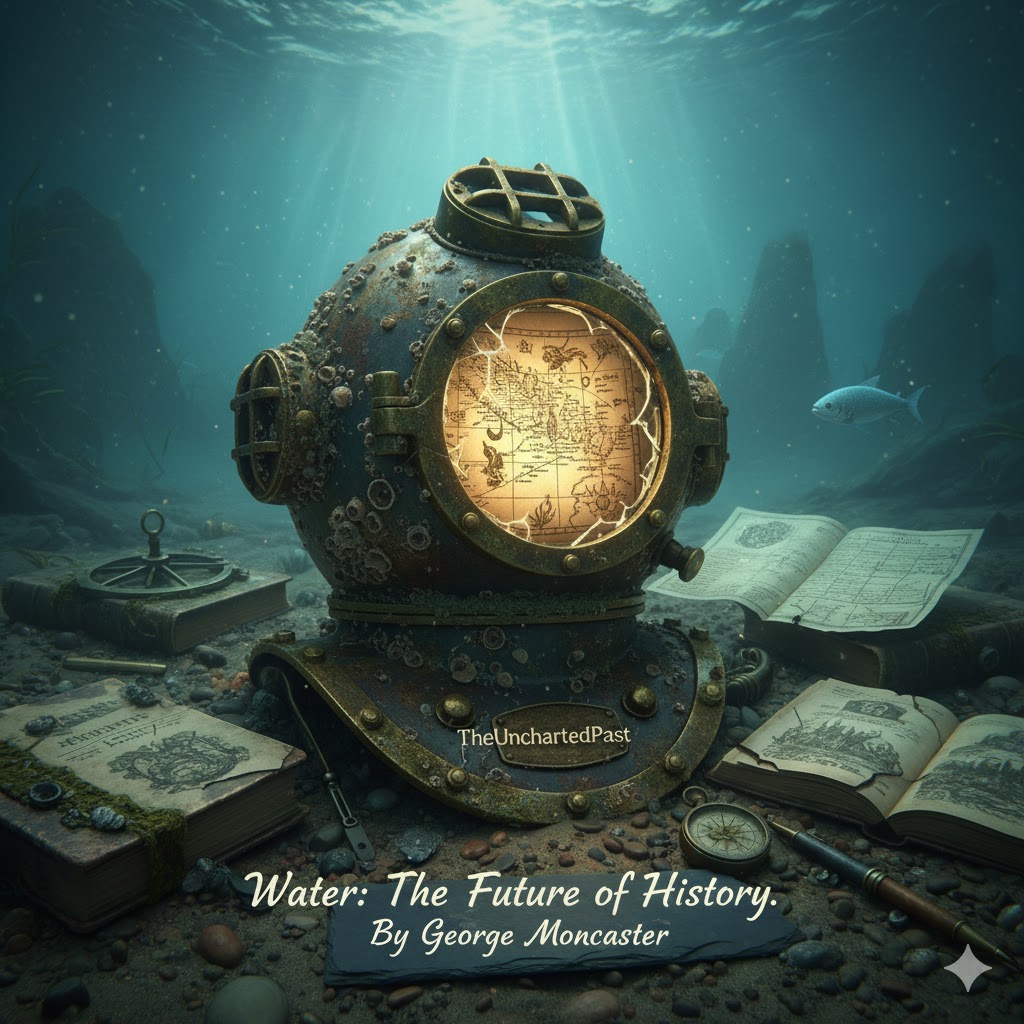
Blue, Green, and Gold: Water and Applied History
Academically inclined historians have a somewhat hard time justifying their existence at the moment. With looming economic uncertainty, young adults are seeing less value in university-level education, especially within the humanities[1] Spending three or four years, then another one or two, sometimes even six years in postgraduate studies to become overqualified (then facing being replaced by AI) is a bleak proposition for those unable to rely on external financial support or simply research for pleasure. Getting funding to support studies in the historical realm is a unique challenge that prospective students are grappling with currently. DTP programs in the United Kingdom offer fewer funded positions than ever before, while some programs in the United States have halted enrolment entirely for the 2025/2026 year. Candidates already in the pipeline compete for increasingly limited postdoctoral positions, let alone full-time work. I seek to offer a suggestion for historians and practitioners interested in working on topics outside the academy. By engaging water as a subject, historians can open doors into projects that have them working in larger multidisciplinary teams, often for direct public benefit. Further, for those unversed, environmental history as it is discussed here refers broadly to the study of relationships between humans and the environment.
Water history is in a unique position to demonstrate powerful methods by which historians can apply historical research in an economic moment that does not seem otherwise encouraging to the wider discipline. Many of these methods are already being demonstrated in heritage and preservation sectors, where degree holders work across teams with broad skills to solve, regulate, and enforce legislation. Other humanities-based disciplines have, for a long time, justified funding by addressing issues such as policy, management, and responses to challenges in the environment. The approach is not a new one, even in bygone years, and to see the humanities as separate from the problem-solving ability of STEM subjects has already been dismissed by influential thinkers such as Susan Sontag in her 1965 work ‘One Culture and the New Sensibility’[2] Sontag assaulted the assumption that a chasm existed between the “literary-artistic and the scientific”, and put the origins of an ill-conceived split somewhere in the realm of the industrial revolution. Interestingly enough, the same period was identified by prominent environmental historian Richard White in his now dated article discussing the romanticism of medieval forms of labour as the separation of man from the elusive ‘nature’[3]
Theoretical discussions aside, water specifically operates as a gateway for historians to heed the call of Paul Warde, Paul Sabin, and Sverker Sörlin, amongst others. That being, a general understanding that “History guides policy choices, inspires proposals for action, and structures institutional thinking”[4] The nature of such an idea has an established precedent, with Joel Tarr and Peter N. Stearn developing an ‘Applied History’ program at Carnegie-Mellon in the mid-1970s and 80s. Specifically, both sought to embody Progressive era ideals of applied knowledge, training then doctoral candidates in policy research methods[5] Considering the bleak economic prospects of that period, compared with prospects faced today, it is no wonder that repeated calls have been made for historians to seek non-academic avenues of employment. Several expansive organisations spring to mind, including Historical Research Associates and Know History Inc. in North America, as well as the History & Policy group in the UK. All three operate in an industry setting, with contracted work. HRA specifically has contributed to cases settling water rights disputes in the western United States. History & Policy published as recently as 2024 suggesting changes to legislation on the Thames River, by providing details of management schemes pursued in the 1960s[6]
Water issues then, operate on a longer timescale when compared to other forms of climate work being undertaken to produce ‘proposals for action’. As a tool for energy, the water wheel predates the rise of fossil fuels and has remained in use as petroleum begins to wax and wane. As a force to be reckoned with, flooding appears in some of the earliest written records ever discovered, and continues to be an issue even after the construction of large river works, sometimes even more so because of infrastructure. As a challenge to be faced, now more than ever, there is a great deal of history to draw on in order to inform how we approach, manage, and legislate water. In essence, historians are capable of working directly with specialists engaged in making technical decisions, influencing policy, and collecting data. Water as a subject for historians provides a field in which this capability can and is being demonstrated.
Materialist environmental histories are especially adept at approaching problems that are asked equally of hydrogeologists, civil engineers, municipal planners, and resource managers. These kinds of histories are chiefly interested in the tangible data produced by reading the landscapes around us. This isn’t to say a historian could go out and blast a tunnel, but they could understand the need for a tunnel, why it has or had to be built in a certain place, and who’s paying for it. Some of the earliest water history writers were, in fact, technical experts who wore multiple hats. Lawrence B. Lee wrote in 1988 that the field of water history was often comprised of “by and large, the handiwork of non-professional historians starting off with the celebrated John Wesley Powell and including some famous engineers such as Frederick Newell, Elwood Mead…politician Steward Udall and government administrator William Warne.”[7] Of course, Lee’s American approach had little scope left for the inclusion of European agricultural historians who had written about soil, water, and crop sciences before the advent of environmental history in the United States. Regardless, John McNeill acknowledges the allure of the materialist realm for environmental historians in his 2003 survey of the field. He described how materialist approaches are chiefly concerned with “the economic and technological sides of human affairs”[8]
McNeil encouraged the field over two decades ago to write “books that others can readily understand and will choose to read” going as far as to build “real intellectual bridges to the territories of other specialists”[9] He might have been thinking chiefly of historical geographers and reminiscing on the proactive landscape of the 1970s, but the point remains pertinent.
Water histories offer a confluence of these approaches. Not only do challenging problems exist to be solved, but these problems often have serious implications in what McNeil identified as the economic and technological realms. Take for example, the rich literature concerned with water management in the American West. Donald Worster identified the concept of a hydraulic society as early as the 1980s, and the framework has remained useful for understanding how and why federal agencies have such an important role to play in western states[10] His identification of a technocratic class is admittedly dated, but at the time shed light on how the landscape was being managed, how it had come to be, and hinted at the problems that could arise from such decisions. Problems that are now more present than ever as the Colorado River compact sees another round of negotiation. Christian Harrison in All the Water the Law Allows highlighted the historic management of Nevada’s water supply, with current managers drawing lessons from the conglomeration of stakeholders[11] Marc Reisner demonstrates also Lee’s point, once again wearing multiple hats as both a journalist and historian. His predictions for the Klamath basin in Cadillac Desert are an obvious case and point. In 1986, he suggested removal of the then outdated infrastructure, which was made a reality in 2024[12]
There is some promising work being done in this realm already. Daniel Macfarlane and Murray Clamen edited in 2020 a comprehensive history of the International Joint Commission, a legislative body responsible for managing trans-boundary water management in North America[13] Marc Landry, Matthew Evenden and Julie Cohn have released work documenting how war time contexts mobilised the development of hydroelectric schemes[14] Work by Per Högselius has revealed the practical impact of water as it relates to nuclear power across Europe, especially pertinent in contemporary energy debates[15] In the UK, funding for a new round of sponsored projects relating to water histories has been granted at the Hull under Briony McDonagh and Stuart Mottram[16]
What these projects share is in an interest in how water has been managed, treated, and used to develop structures of power in both literal and human senses. Water history then can and should be, an avenue in which the discipline can directly contribute to debates in which understanding the development of such power becomes not a tertiary or separated benefit, but a direct and critical part of a wider, multidisciplinary solution. Multidisciplined efforts bring applicability, and applicability brings funding. As the current moment increases demands on water, understanding its past is not only a tool for the historian but a method by which non-academic entities can begin to suggest notions of water futures.
References/Footnotes:
[1]‘Why Today’s Graduates Are Screwed’, The Economist, 16 June 2025, https://www.economist.com/finance-and-economics/2025/06/16/why-todays-graduates-are-screwed.
[2] Susan Sontag, ‘One Culture and the New Sensibility’, in Against Interpretation, and Other Essays (Farrar, Straus & Giroux, 1966).
[3] Richard White, ‘“Are You an Environmentalist or Do You Work for a Living”: Work and Nature’, in Uncommon Ground: Rethinking the Human Place in Nature (W. W. Norton & Company, 1997).
[4] Paul Sabin, ‘“The Ultimate Environmental Dilemma”: Making a Place for Historians in the Climate Change and Energy Debates’, Environmental History 15, no. 1 (2010): 76–93.
[5]Peter N. Stearns and Joel A. Tarr, ‘Curriculum in Applied History: Toward the Future’, The Public Historian 9, no. 3 (1987): 111–25, https://doi.org/10.2307/3377191.
[6]‘Why Thames Water Is Top of Sue Gray’s Risk Register’, History & Policy, 2024, accessed 5 January 2026, https://historyandpolicy.org/policy-papers/papers/why-thames-water-is-top-of-sue-grays-risk-register/.
[7] Lawrence B. Lee, “Water Resource History: A New Historiography?”, Pacific Historical Review, Vol. 57 No. 4 (1988), 458-460.
[8] J. R. McNeill, ‘Observations on the Nature and Culture of Environmental History’, History and Theory 42, no. 4 (2003): 5–43 (6).
[9] J. R. McNeill, ‘Observations on the Nature and Culture of Environmental History’, History and Theory 42, no. 4 (2003): 5–43 (9).
[10] Donald Worster, Rivers Of Empire: Water, Aridity, and the Growth of the American West (Oxford University Press, 1985).
[11] Christian S. Harrison, All the Water the Law Allows: Las Vegas and Colorado River Politics (University of Oklahoma Press, 2021).
[12] Marc Reisner, Cadillac Desert: The American West and Its Disappearing Water (Penguin Books, 1993).
[13] Murray Clamen and Daniel Macfarlane, eds, The First Century of the International Joint Commission (University of Calgary Press, 2020), https://library.oapen.org/handle/20.500.12657/57529.
[14] Julie Cohn et al., ‘Water Powers: The Second World War and the Mobilization of Hydroelectricity in Canada, the United States, and Germany’, Journal of Global History 15 (March 2020): 123–47, https://doi.org/10.1017/S1740022819000366.
[15] ‘The Project’, NUCLEAR WATERS, 11 March 2019, https://nuclearwaters.eu/project/.
[16] ‘Living Well with Water Doctoral Focal Awards’, accessed 5 January 2026, https://www.hull.ac.uk/study/postgraduate-research/funded-opportunities/living-well-with-water.
Author:
 English